Quantum Understanding and AI for Interpretability and Learning.
May 2025. FLIQ Virtual Hackathon — organised by the Quantum Coalition, ITU, and the International Year of Quantum Science and Technology, powered by IonQ. Didn't place.
the problem
Drug-induced autoimmunity (DIA) is a serious and poorly understood side effect of certain pharmaceutical compounds — the drug triggers the immune system to attack the body's own tissue. Predicting which compounds might cause this before clinical trials is a hard classification problem with real stakes.

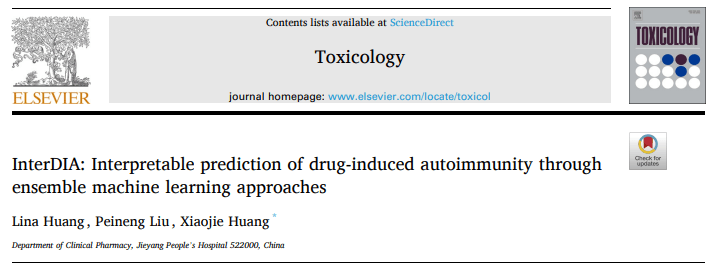
Classical ML models can do it, but they're black boxes. You get a prediction; you don't get to know why a molecule was flagged. The prior art we built on was InterDIA, an ensemble ML approach from the literature — interpretable, but classical.
For pharmaceutical safety decisions, interpretability isn't optional. We wanted to see if a quantum approach could match classical performance while being explainable.
what we built
QUAIL is a hybrid quantum-classical architecture:
- Classical dimensionality reduction — 196 RDKit molecular descriptors compressed to 2–6 features via a trained linear layer
- Variational Quantum Classifier — the reduced features are encoded into a parameterised quantum circuit (ZZFeatureMap + RealAmplitudes ansatz) running on 2–6 qubits using Qiskit's StatevectorEstimator
- Classical output layer — standard classification head on top of the quantum circuit's output
Dataset: 477 molecules with binary DIA labels.
the data
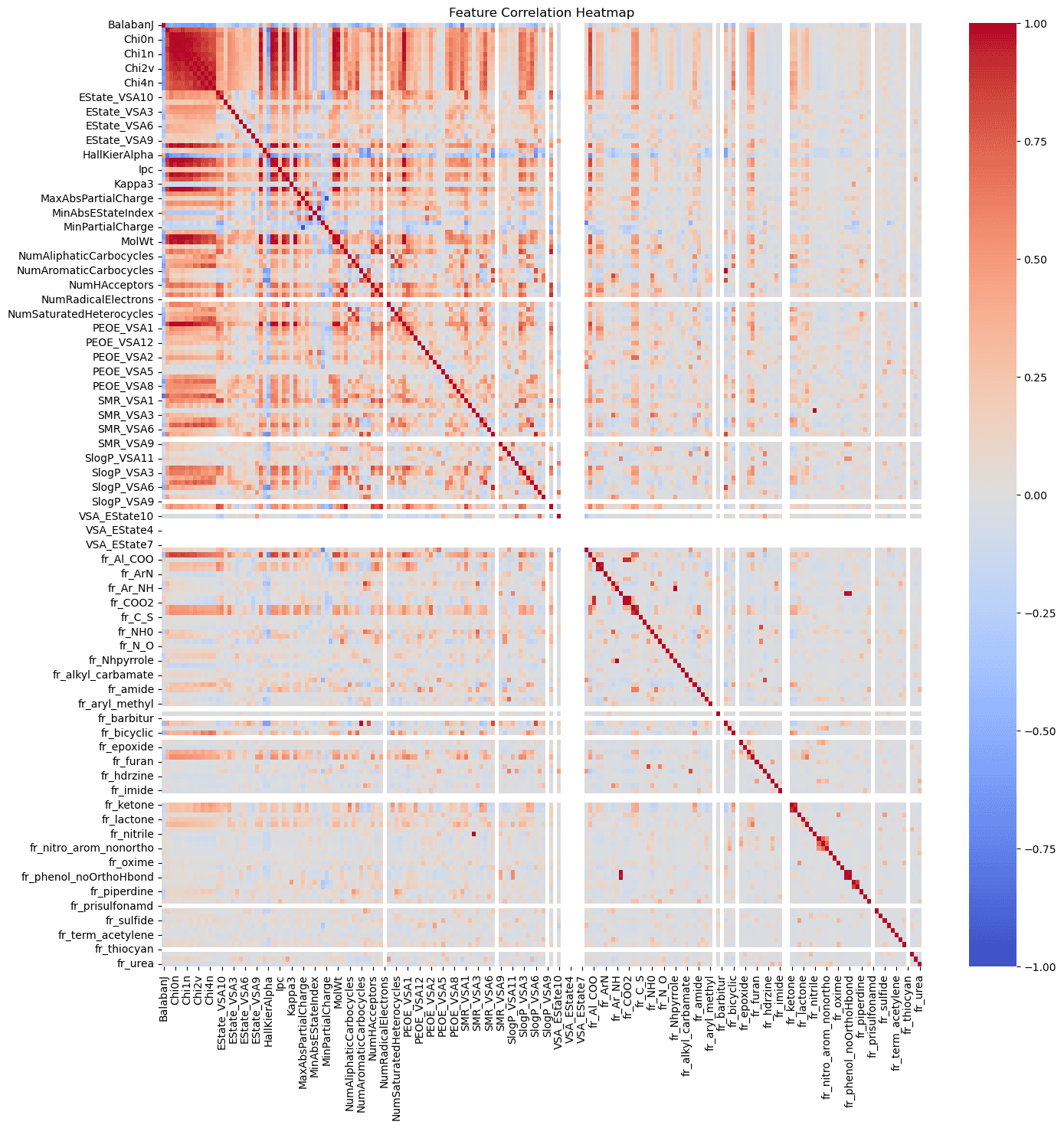
The 196 molecular descriptors are highly correlated — understanding the feature space was an important first step before deciding what to reduce and how.
baseline
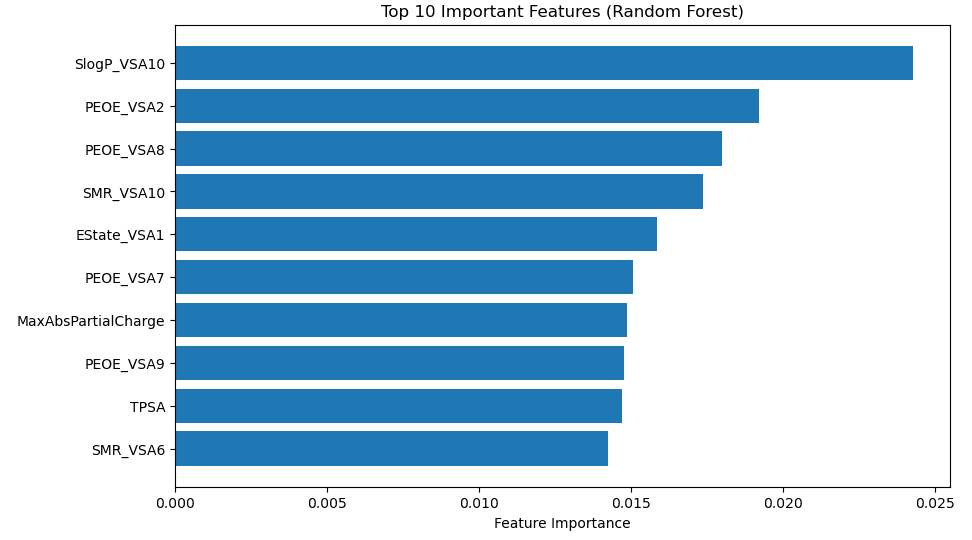
We benchmarked against Logistic Regression and Random Forest. The Random Forest feature importance gave us a classical reference for which molecular properties actually matter for DIA prediction.
the novel contribution: IPA
The more interesting part was the interpretability method.
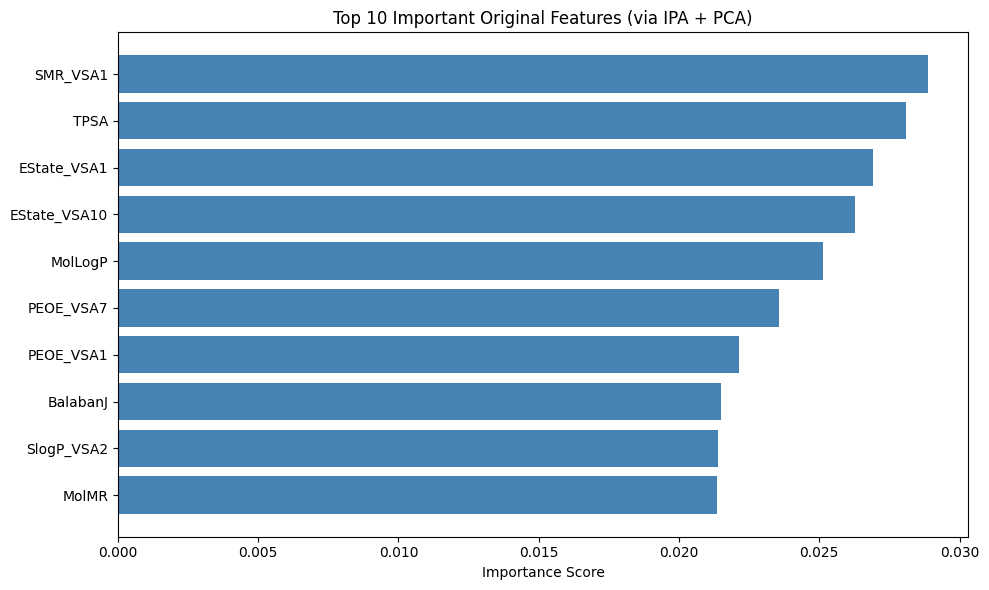
Quantum models are even more opaque than classical neural networks. We developed Input Perturbation Attribution (IPA): perturb each PCA-reduced feature by a small angle, measure the change in prediction probability, assign an importance score, then use PCA loading weights to map those scores back to the original 196 chemical descriptors.
The result: a molecular-level explanation of why a compound was flagged — expressed in terms of chemical features a pharmaceutical scientist can actually act on.
As far as we could find, this combination of VQC + IPA + PCA back-projection for quantum model interpretability hadn't been demonstrated in the existing literature.
stack
Python, PyTorch, Qiskit 1.x, RDKit, scikit-learn
reflection
Quantum ML is still very early. The VQC didn't outperform Random Forest — that wasn't really the point. The point was whether quantum models could be made explainable in a domain-relevant way. I think we showed they can.
I came into this knowing essentially nothing about quantum computing. Left knowing just enough to appreciate how much I still don't know.