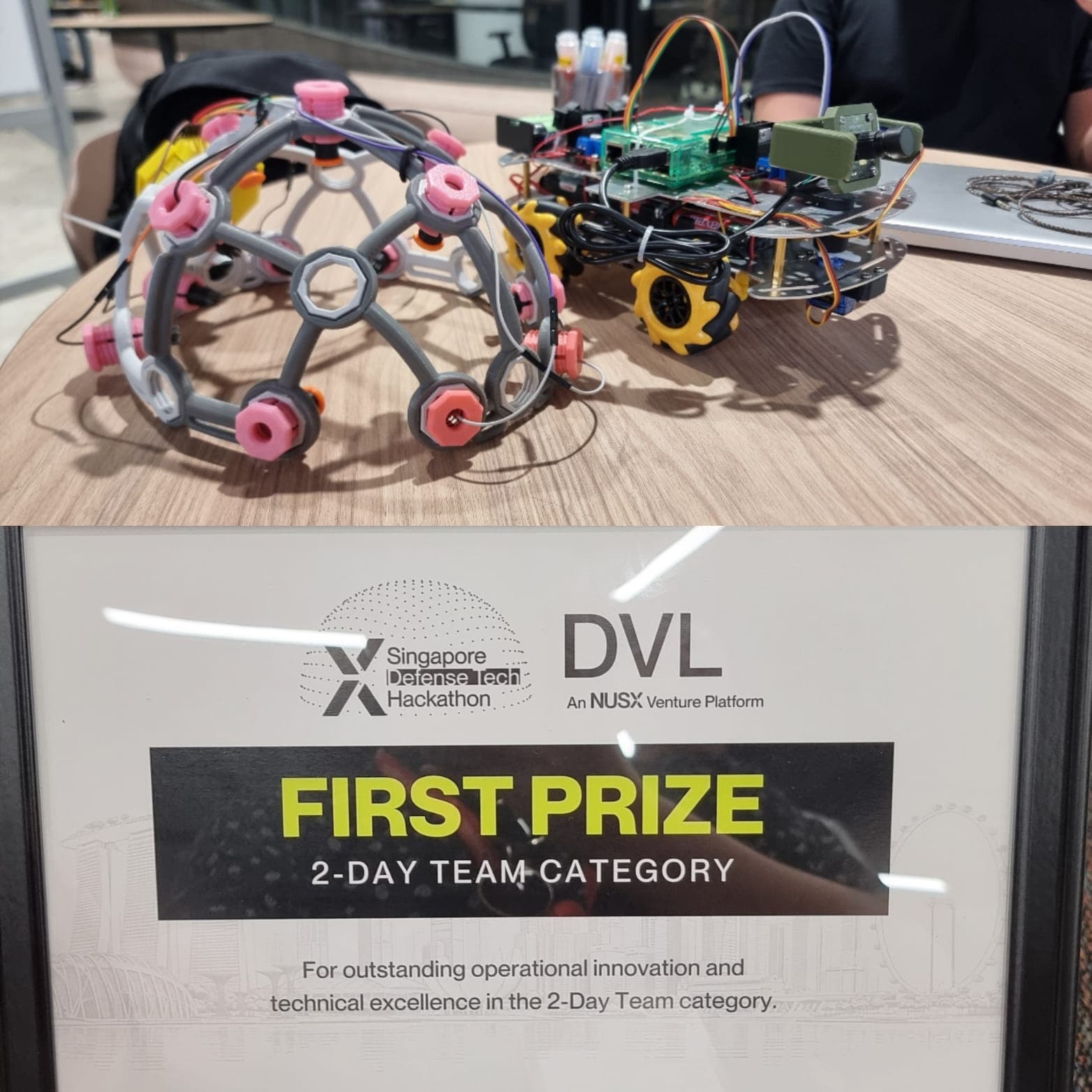
25–27 September 2026. Drive a robot with your eyes. Built by team NeuroMech at the Singapore Defense Tech Hackathon, part of A5X, an NUSX event. First Prize, 2-Day Team Category — S$8,000, first of 39 teams that built working prototypes in 48 hours, awarded by DVL, the Defence Venture Lab (an NUSX venture platform), "for outstanding operational innovation and technical excellence." The event also ran a separate 3-month track. (Press release)
The brain-computer interface side builds on tech I've been developing under Mind Interface Company (MIC). The hackathon was a chance to put MIC's BCI on a real robot, in a defence context, against a deadline.

the idea
The operator wears an EEG headset and watches a screen showing the robot's view. Four circles surround it — up, down, left, right — each flickering at its own frequency. Looking at a circle produces an SSVEP (steady-state visually evoked potential): a brain response over the visual cortex at that circle's frequency. The laptop decodes which circle you're looking at and drives a 4-wheel mecanum rover forward, back, or sideways.
No joystick, no hands. Just where you look.
Cyton headset ──USB radio dongle──► laptop hub ──UDP──► rover (Raspberry Pi)
                                        │
                                        └──► operator display: robot view + 4 flicker circles
the pitch
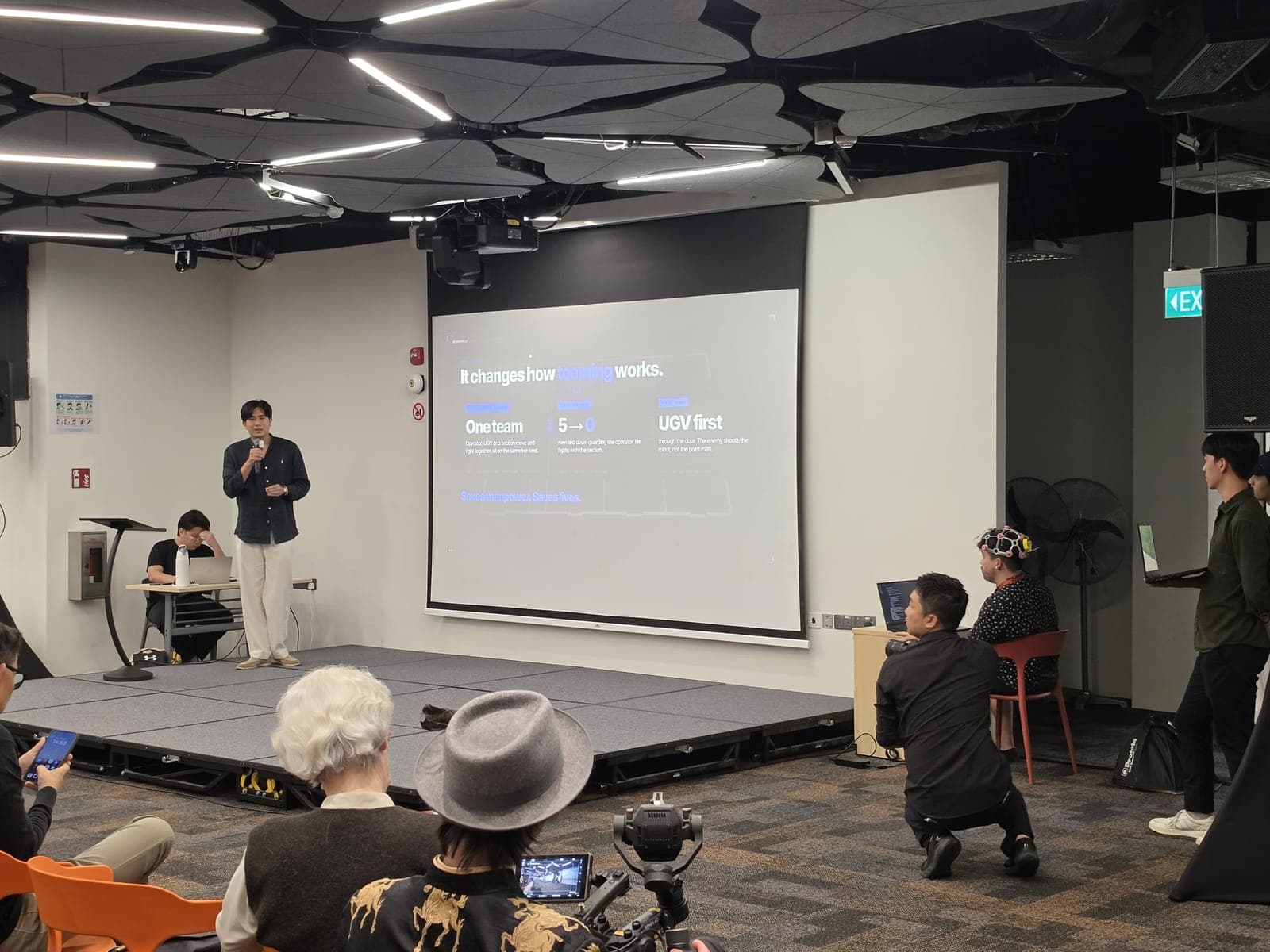
The operational case is manned-unmanned teaming. Today, a soldier driving a ground robot has their hands and eyes on a controller — and other soldiers get tied down guarding them. Drive it by gaze instead, and:
- One team — operator, UGV, and section move and fight together, all on the same live feed.
- 5 → 0 — men tied down guarding the operator. The operator fights with the section.
- UGV first — the robot goes through the door first. The enemy shoots the robot, not the point man.
Saves manpower. Saves lives.
two ways to drive
Hold (default) — the rover moves while you keep looking at a circle, and stops about 2 seconds after you look away.
Latch — look at a circle to select it, clench your jaw to go, clench again to stop. The jaw clench is picked up as muscle noise (EMG) on the same headset, with a guided recorder to tune the threshold per operator. It releases on its own after 3 seconds.
what we built
- Decoding — training-free filter-bank CCA on four electrodes (O1, O2, P7, P8) of an OpenBCI Cyton. On a clean recording it scored 94% accuracy at a 2-second window (100% at 3 s). Plain CCA beat the trained TRCA models on every recording we took, so there's no per-user calibration step.
- Operator display — a Python/psychopy window, not a browser. It holds 120 fps on the laptop panel with exact flicker frequencies (11/14/17/20 Hz), measured from real frame times. Flicker is computed from the frame timestamp, never a frame counter, so refresh-rate jitter can't smear the signal.
- Laptop hub — one Python process: EEG engine, decoder, a safety arbiter, WebSockets, and a newest-frame-wins video relay so latency can't build up.
- Rover link — the hub's commands become UDP
FWD/BACK/LEFT/RIGHT/STOPto a Raspberry Pi on the rover, which brakes itself if packets stop for 0.6 s. - Virtual robot — a CPU-rendered 3D arena with a first-person camera, plus a three.js digital twin, so the whole loop could be tested end to end before the physical rover existed.
- Tests — 134 automated tests, plus end-to-end scripts that run the full loop in simulation with a fake EEG board.
safety first
It's a defence hackathon, and it's a robot driven by brain signals — so the safety model was non-negotiable. The rover only moves while armed; the hub starts disarmed; any lost link (display, EEG, robot) disarms; re-arming is explicit; and every layer — hub bridge and the Pi itself — stops the robot on its own if commands go quiet.
what we learned
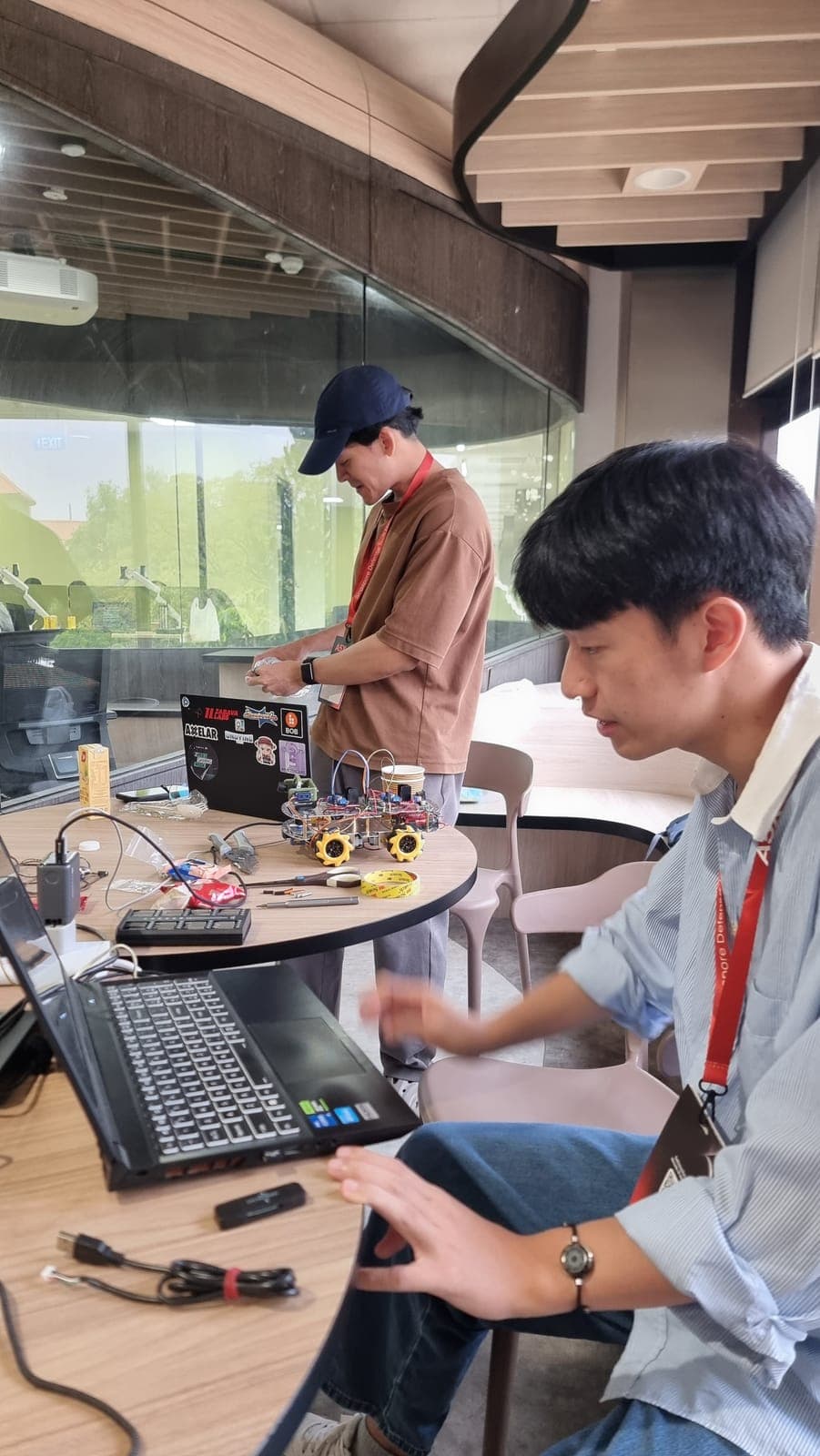
- Hardware is where the time goes. The rover's camera browned out every time the motors ran (shared battery), so the display holds the last frame from before the move and goes live again a second after it stops. The rover also strafed the wrong way — mirrored wheels — hence a
--swap-lrflag. - Simple decoders win on small data. Plain CCA beat the trained models, and a 2-second window was the sweet spot: faster response than 3 s, with fewer wrong moves.
- Frequencies matter per person. 11/14/17/20 Hz decoded cleanly for our operator; an alternative set (11/13/15/17.5 Hz) decoded much worse.
- Unplug the charger. Mains noise swamps EEG. Demo prep meant a lot of electrode contact checks.
the team
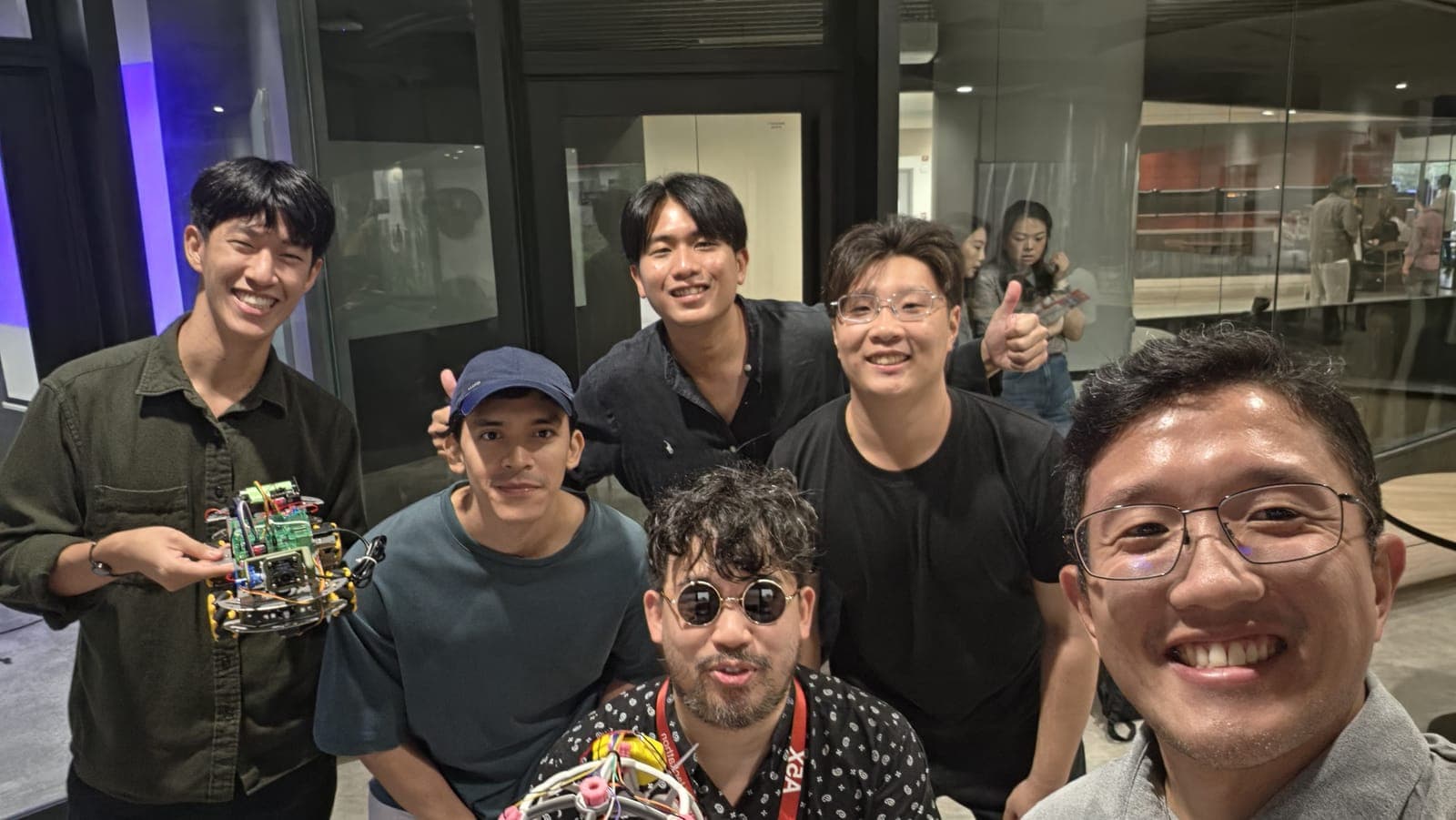
- Jackie Tan Yen — hackathon strategy, coordination, and the BCI
- Richard Xiong — problem validation, slides, and pitching; set up the hackathon project itself, coordinating work across projects with Codor, Tailscale, and an agent harness. Same Richard from Dilly and ebi.
- Iain — problem validation, slides input, and report writing
- Wayne — rover build, and making sure it actually works
- Mud — rover build assistant and rover software
what's next
We're taking NeuroMech forward and applying to DVL, the Defence Venture Lab by NUS Enterprise (now NUSX) — the same venture platform behind the prize.
stack
OpenBCI Cyton, BrainFlow, EEG-ExPy, Python (FastAPI, psychopy, numpy/scipy), three.js, Raspberry Pi with a mecanum-wheel chassis.