May 2023. A strategy deck produced as a director assignment for Deloitte Digital — I'd been invited as a partner candidate but opted for the director track with partner trajectory as a stepping stone. Passed the assignment. Hiring froze when Deloitte changed CEO and the budget closed with it. Never joined.

the brief
Where should Lululemon play in the metaverse, and how?
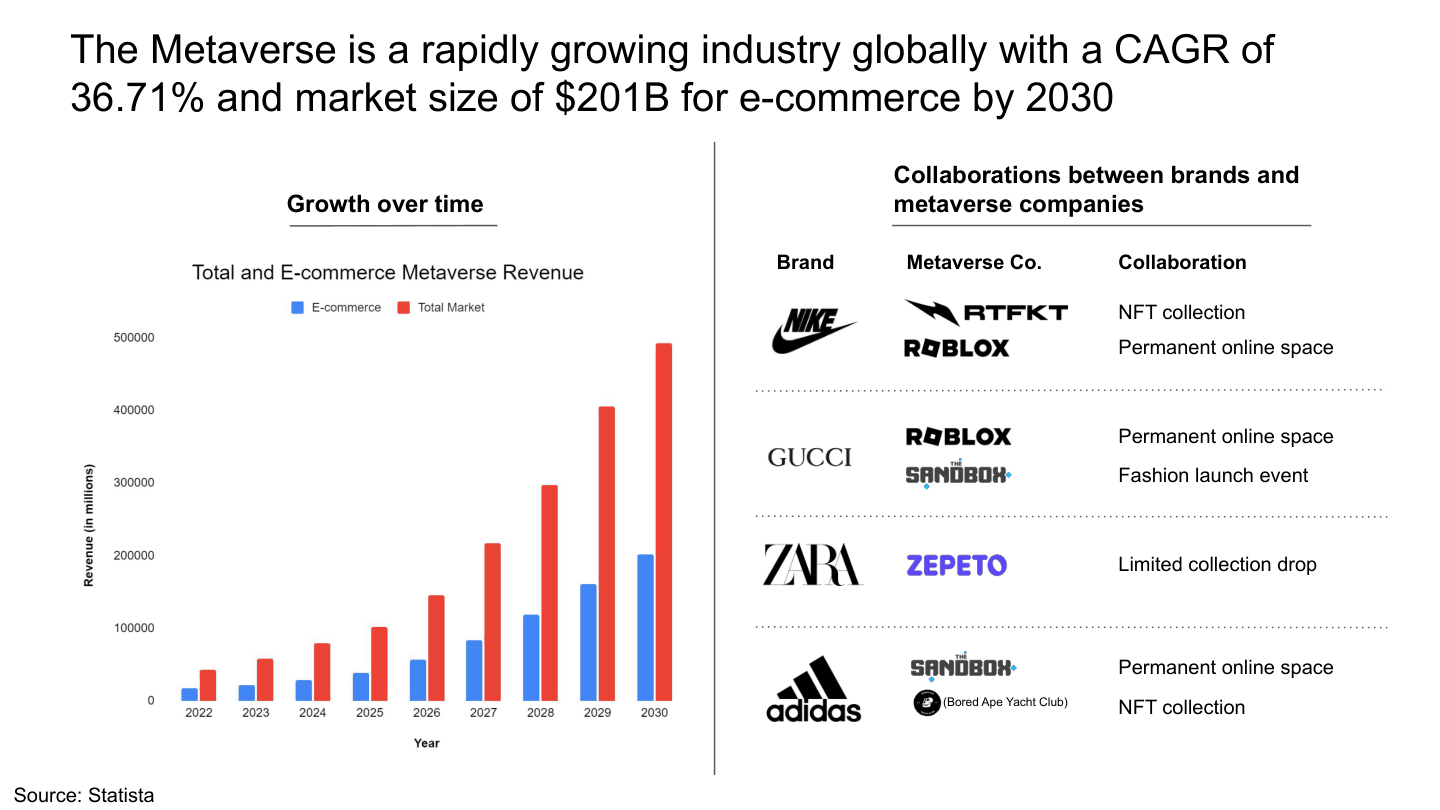
The metaverse e-commerce space was peaking in 2023. Brands were rushing in — Nike on Roblox, Gucci on Sandbox, Adidas with Bored Ape. The question wasn't whether Lululemon should engage, but where and how to do it without wasting money or diluting the brand.
understanding lululemon
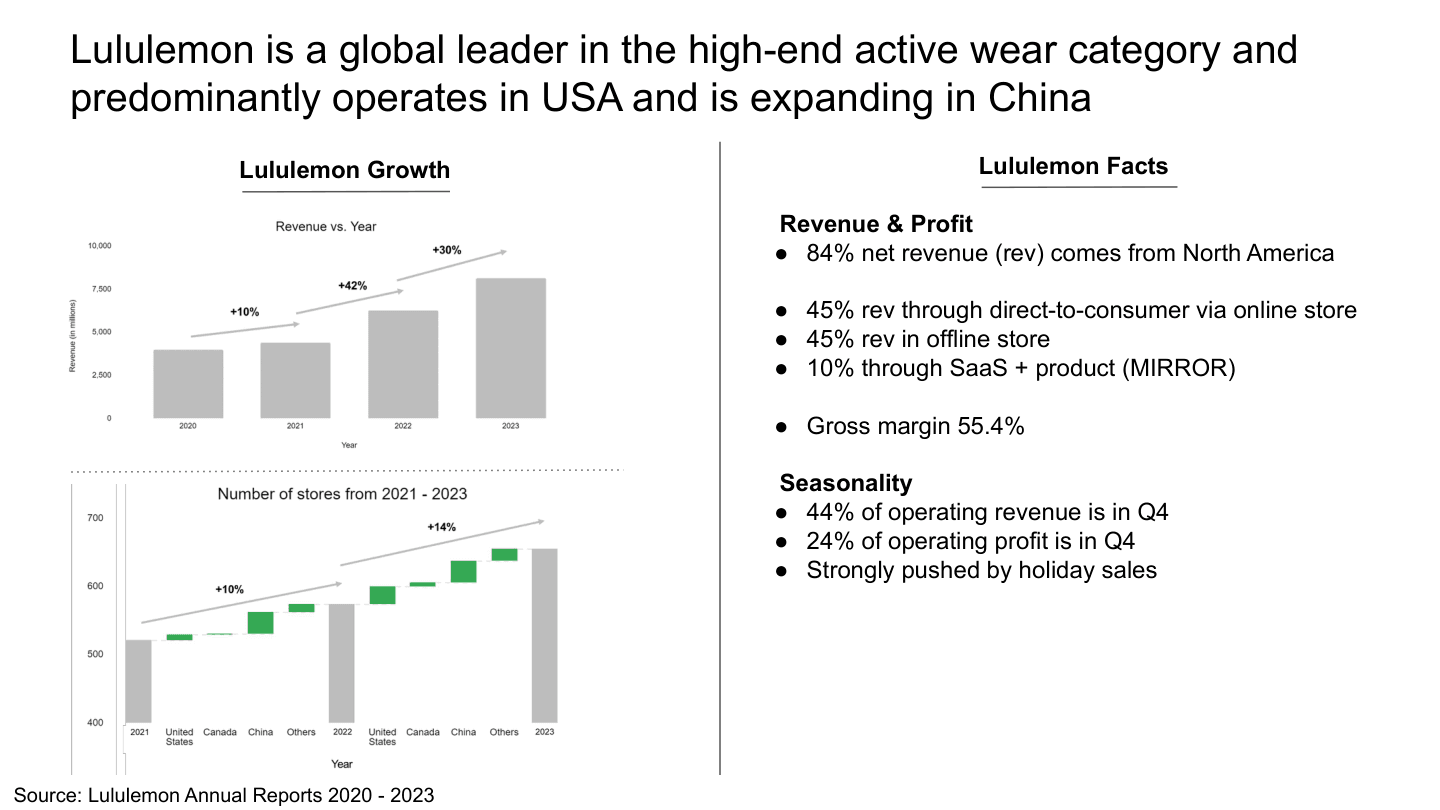
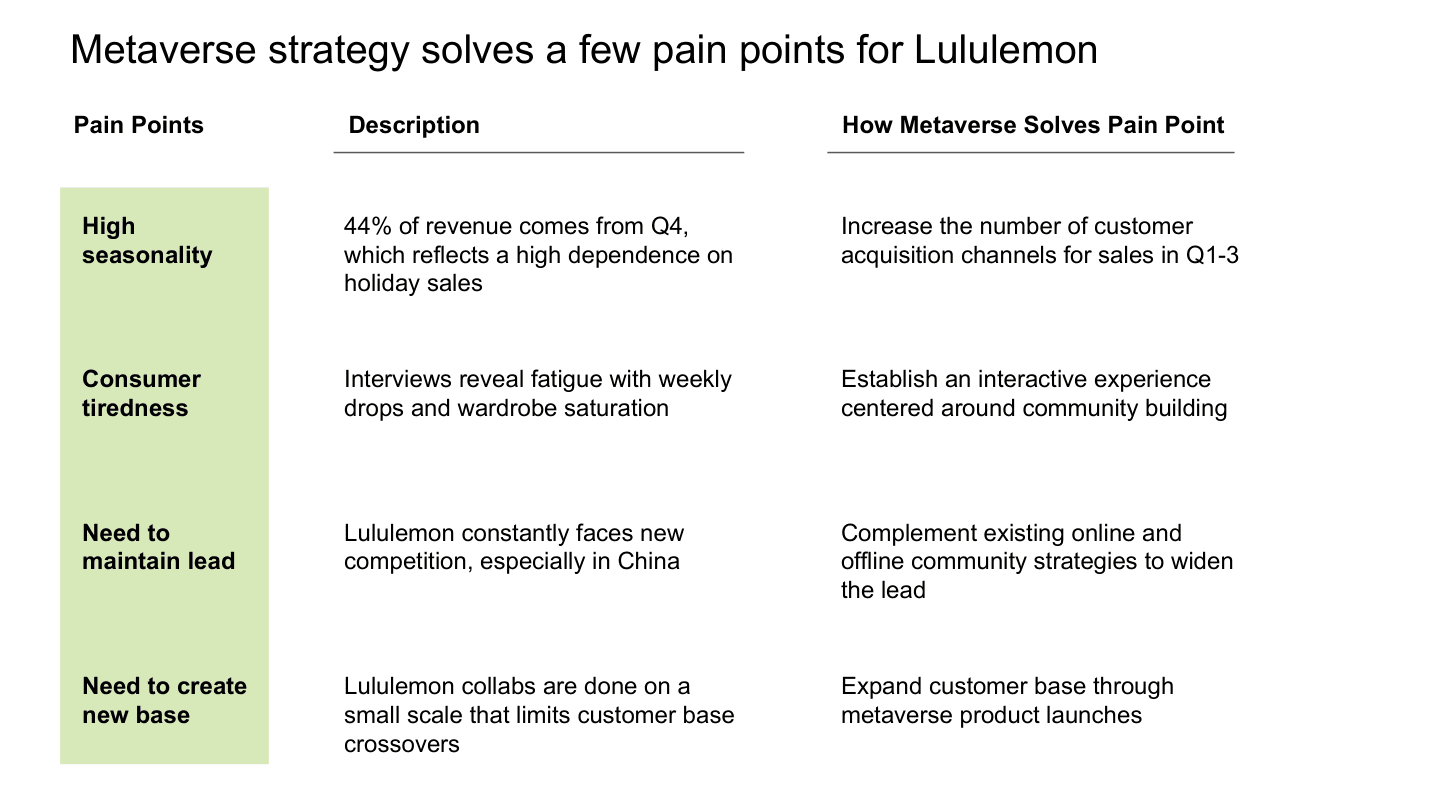
Lululemon was growing fast — 30% YoY revenue growth to 2023, 55.4% gross margin, 84% of revenue from North America. But the business had a structural problem: 44% of operating revenue falls in Q4. Community was their moat — r/lululemon on Reddit is fanatical, and Xiao Hong Shu KOLs were driving China growth — but that community was showing fatigue from weekly drops and wardrobe saturation. Competition in China was intensifying. The metaverse needed to solve real pain points, not just generate press.
mapping the landscape
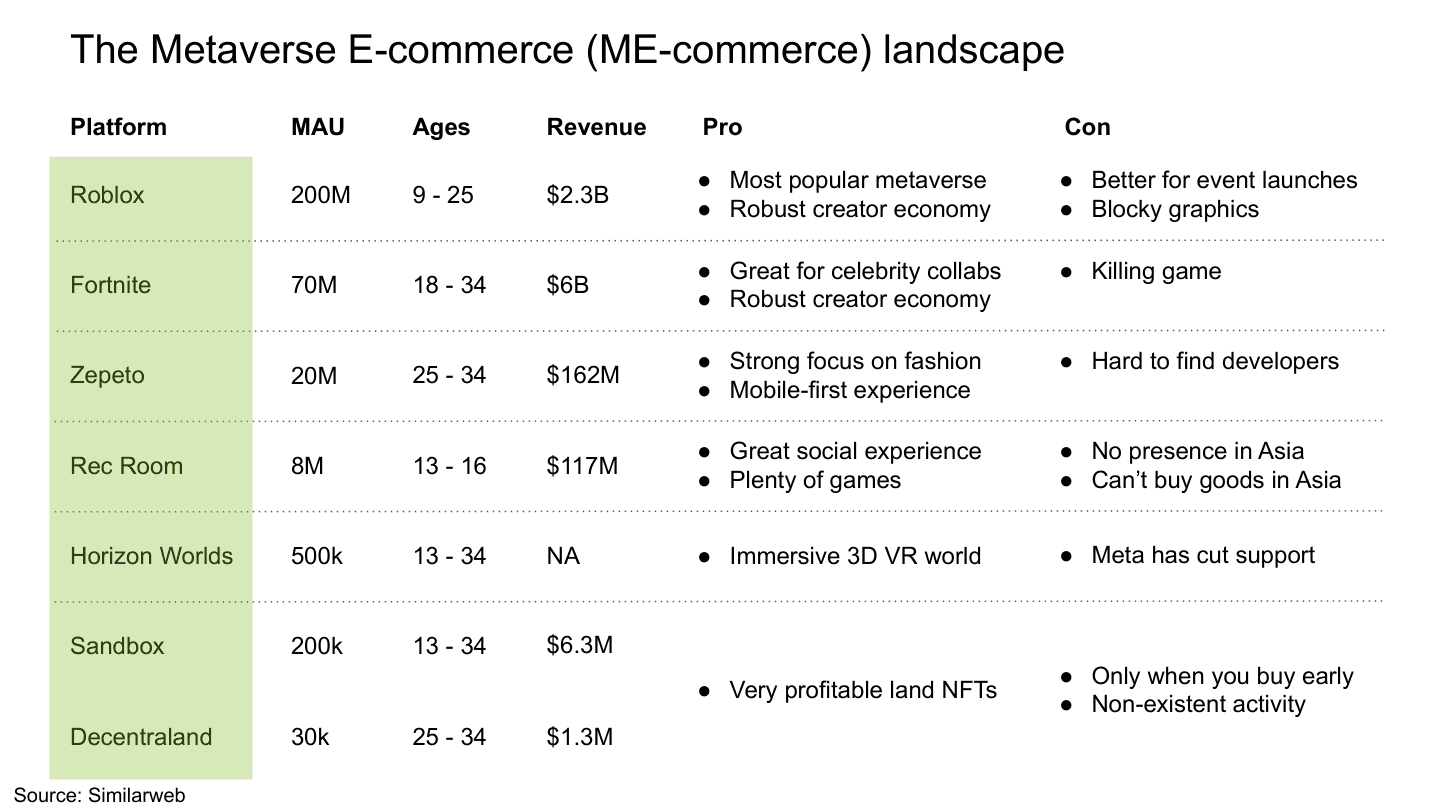
Seven platforms evaluated across MAU, age demographics, revenue, and brand fit. The metaverse e-commerce market was heading to $201B by 2030 (36.71% CAGR). The platforms varied enormously:
- Roblox — 200M MAU, ages 9–25, $2.3B revenue. Most popular, but blocky graphics and better for event launches than persistent brand presence.
- Fortnite — 70M MAU, ages 18–34, $6B revenue. Great for celebrity collabs, but it's fundamentally a killing game.
- Zepeto — 20M MAU, ages 25–34, $162M revenue. Fashion-focused, mobile-first, strong creator economy, growing in Asia.
- Sandbox / Decentraland — tiny active userbases (200k and 30k). Land NFTs were profitable for early buyers; activity was non-existent.
the recommendation: zepeto
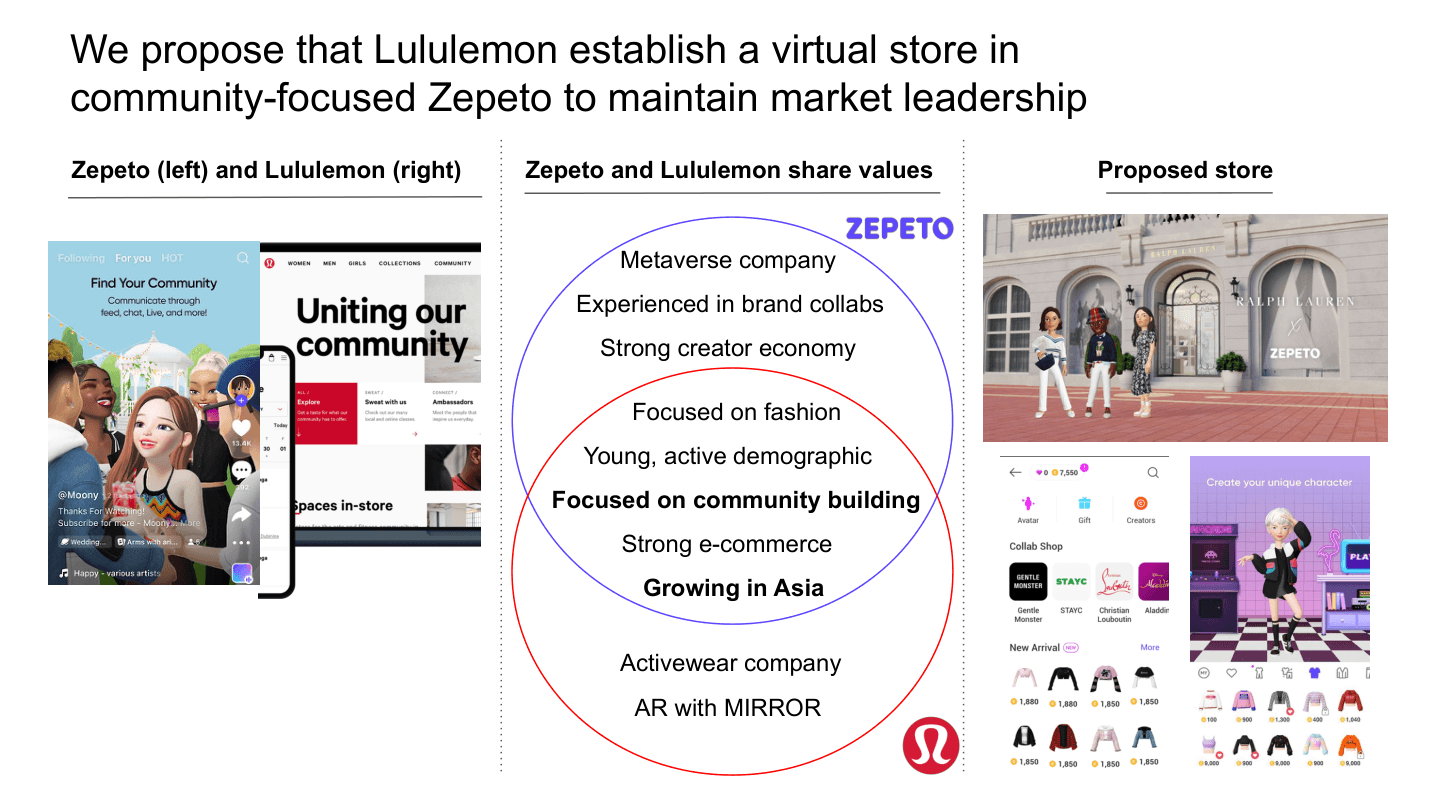
Zepeto, not Roblox. Not NFTs.
The fit was clear: Zepeto is fashion-focused, community-first, growing in Asia (exactly where Lululemon needed traction), and targets the 25–34 demographic — Lululemon's core customer. Both brands are built on community. Both are expanding in Asia. Zepeto had already done brand collabs with Ralph Lauren and Christian Louboutin, and had the creator economy infrastructure to make a virtual Lululemon store work.
On NFTs specifically — the data was unambiguous.
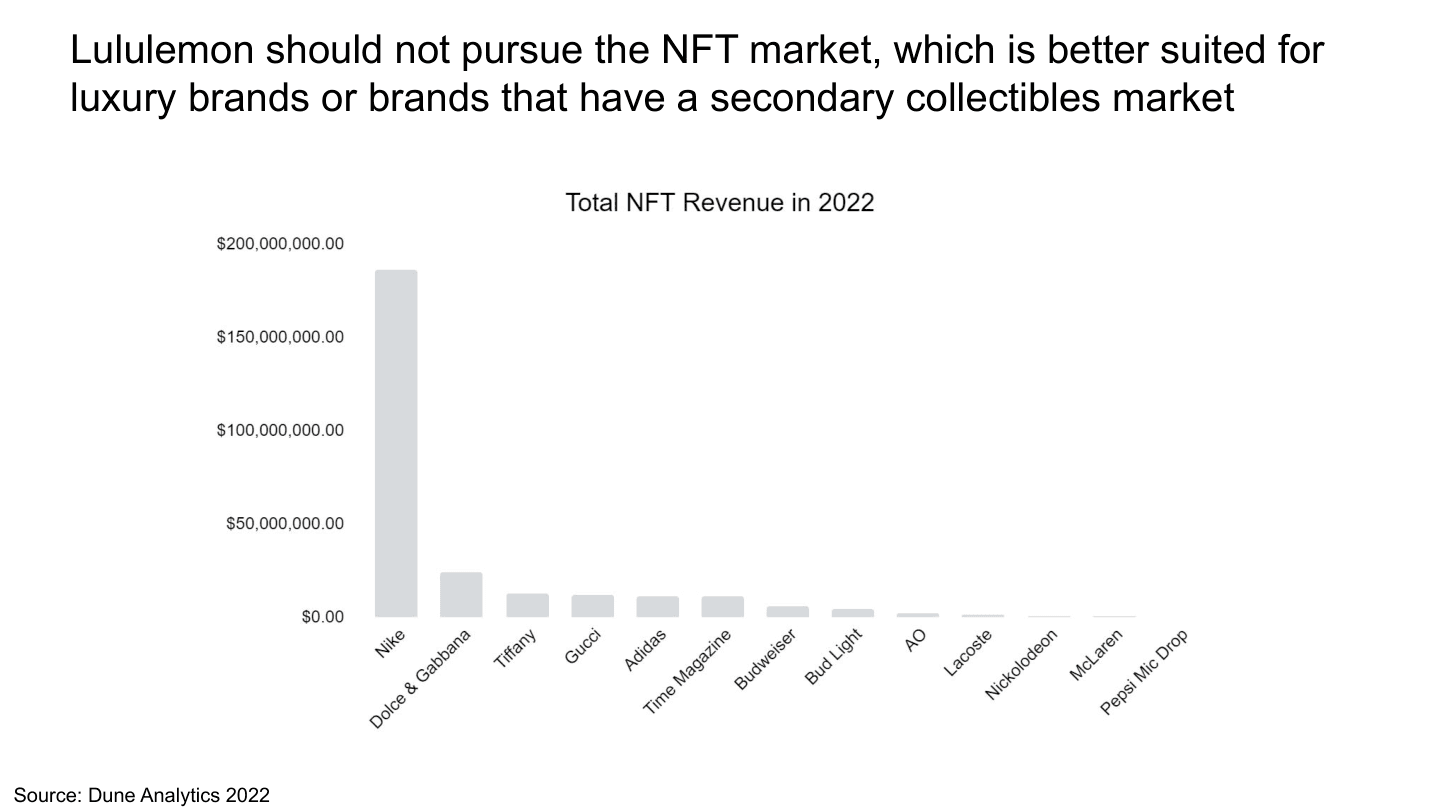
Nike dominated NFT revenue in 2022 at ~$180M. Everyone else was a rounding error. NFTs work for brands with strong secondary collectibles markets and luxury positioning — Tiffany, Gucci, Dolce & Gabbana. Lululemon is premium activewear, not a collectible. Pursuing NFTs would have been chasing hype, not building value.
the ai layer
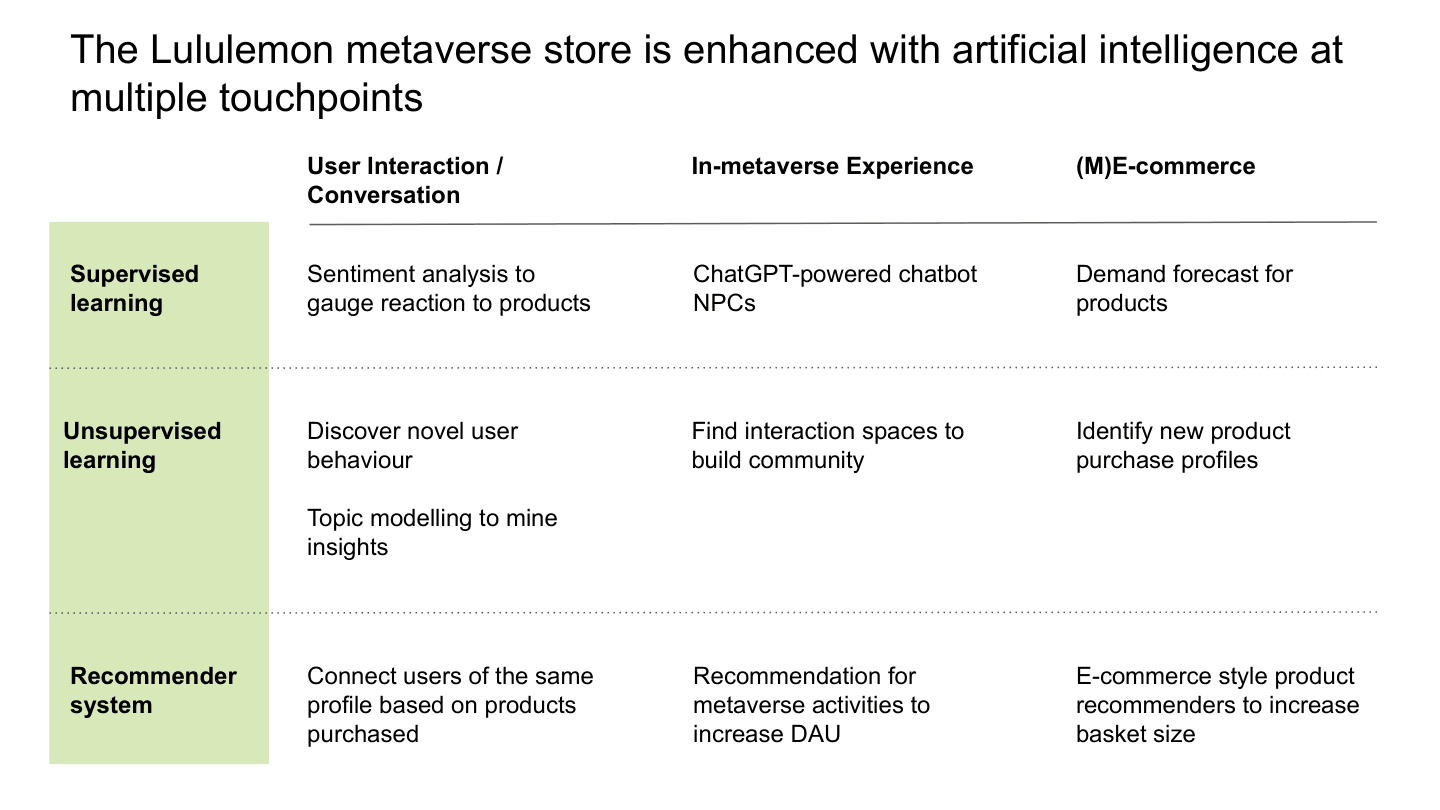
The virtual store was designed with AI across three dimensions:
Supervised learning — sentiment analysis on user reactions to products in-store, ChatGPT-powered NPC chatbots for store interaction, demand forecasting for physical inventory based on metaverse signals.
Unsupervised learning — discovering novel user behaviour clusters, topic modelling from conversations to surface product insights, identifying new purchase profiles.
Recommender systems — connecting users with similar purchase profiles to build community, recommending metaverse activities to increase DAU, e-commerce-style product recommendations to increase basket size.
The metaverse wasn't just a brand activation — it was a data collection layer feeding back into the physical business.
implementation
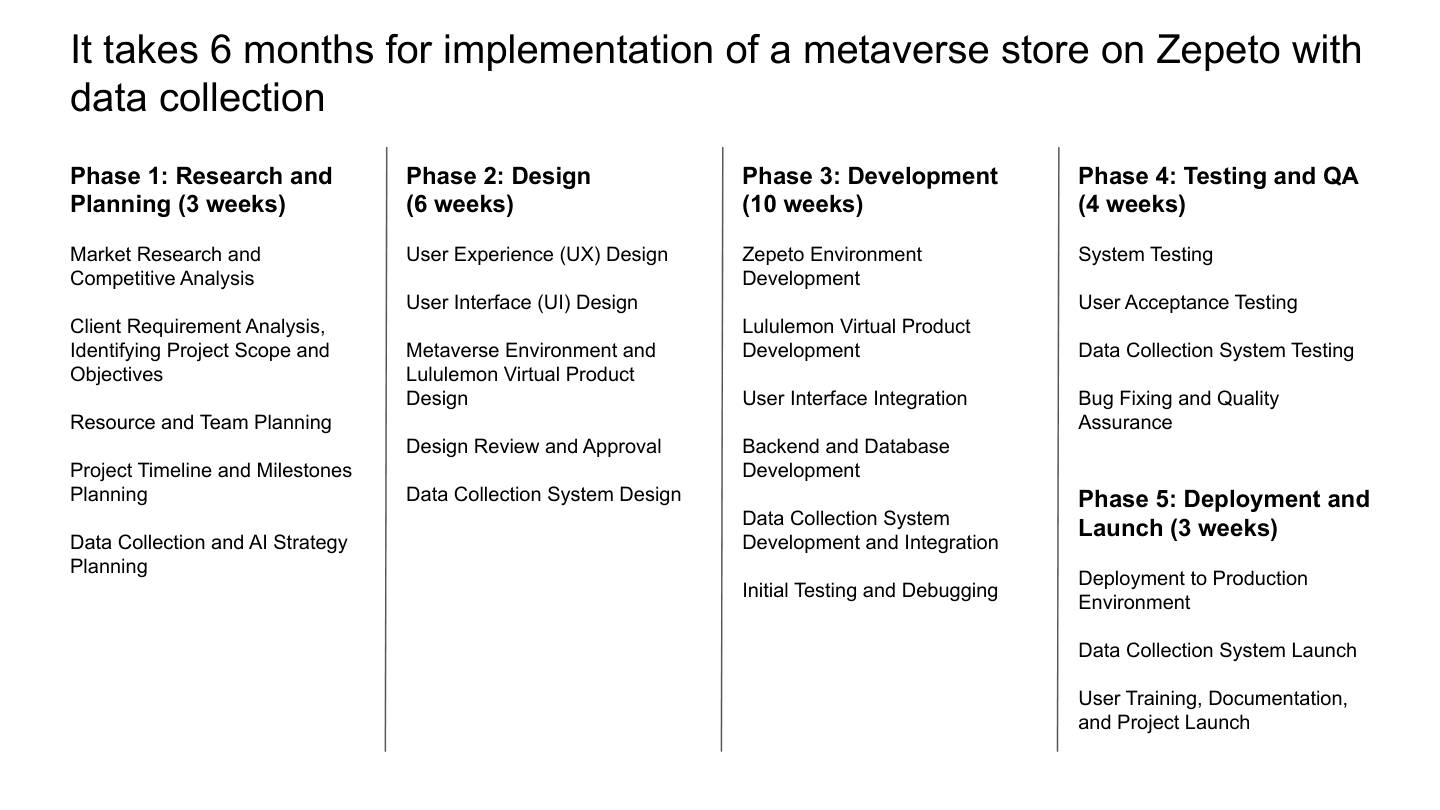
Six months across five phases: research and planning (3 weeks), design (6 weeks), development (10 weeks), testing and QA (4 weeks), deployment (3 weeks). Standard consulting delivery structure with clear risk mitigation — market risk, adoption risk, scope creep, data leakage.
what happened
Passed the assignment. Deloitte changed CEO, budgets closed, hiring froze. Never joined.
I don't know whether the Lululemon strategy was ever presented to the client or adopted. The metaverse hype cycle has since cooled considerably — Horizon Worlds lost Meta's support, Decentraland's active users collapsed, and most brand metaverse experiments quietly wound down. The Zepeto recommendation held up better than most: fashion-focused platforms with real user bases outlasted the speculative land-grab plays.
The interesting part of this exercise wasn't the metaverse — it was the Lululemon analysis. A brand that strong, with community that passionate, doesn't need a gimmick. Whatever channel it enters has to earn its place in the community or it gets ignored.