May 2025. Pitched to ENGIE Factory — the venture building arm of energy company ENGIE — as part of their Entrepreneur-in-Residence search. This was the idea I would have built if selected. They wanted me. I turned it down to join Circles as Product Lead in June 2025.
the problem
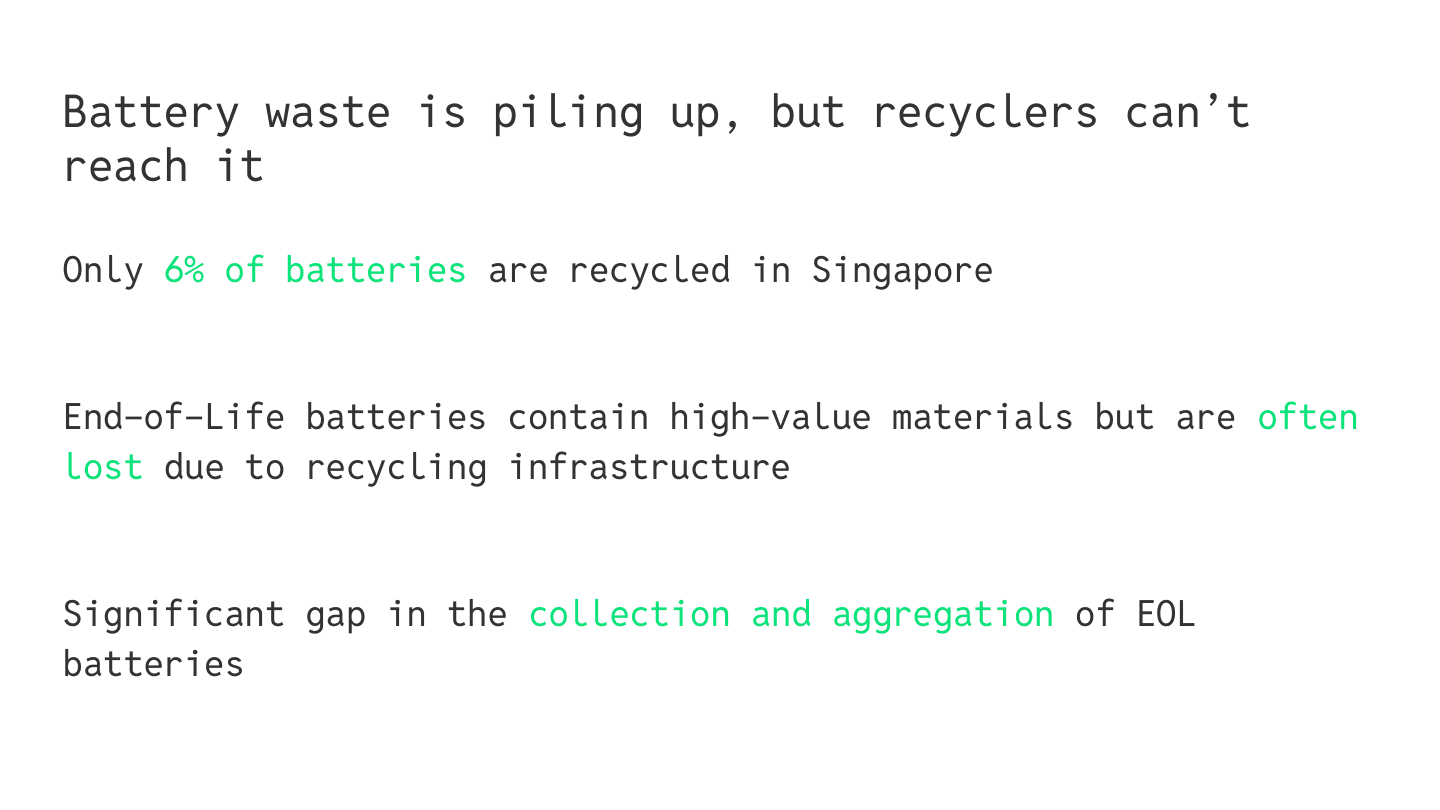
Only 6% of batteries are recycled in Singapore. End-of-life (EOL) batteries contain high-value materials — lithium, cobalt, nickel — but most of it ends up lost because the collection infrastructure doesn't exist to route it anywhere useful. Recyclers want the material. Suppliers have it. Nobody is connecting the two efficiently.
The gap isn't technical. It's logistical and operational — a discovery and aggregation problem dressed up as an environmental one.
what bloop does
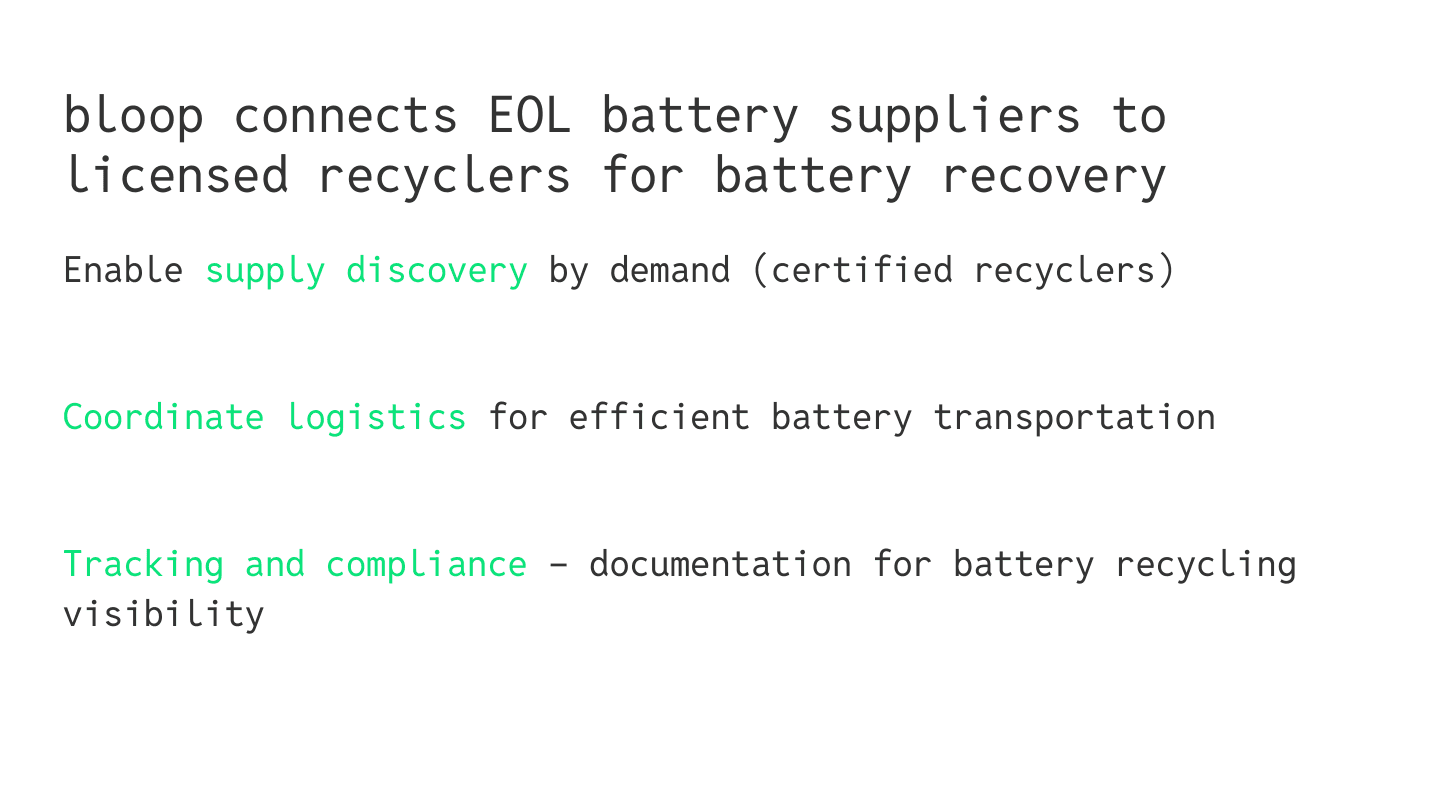
bloop is a B2B marketplace connecting EOL battery suppliers (e-scooter fleets, device manufacturers, logistics operators) to licensed recyclers.
Three things it does:
Supply discovery — certified recyclers can find and bid on available battery stock. The demand side pulls supply out of the grey zone.
Logistics coordination — bloop arranges pickup, routing, and transportation. This is the operational moat; route density is the cost lever.
Tracking and compliance — documentation for battery chain-of-custody. This matters because recyclers need audit trails for downstream processing, and regulators increasingly want to see it.
business model
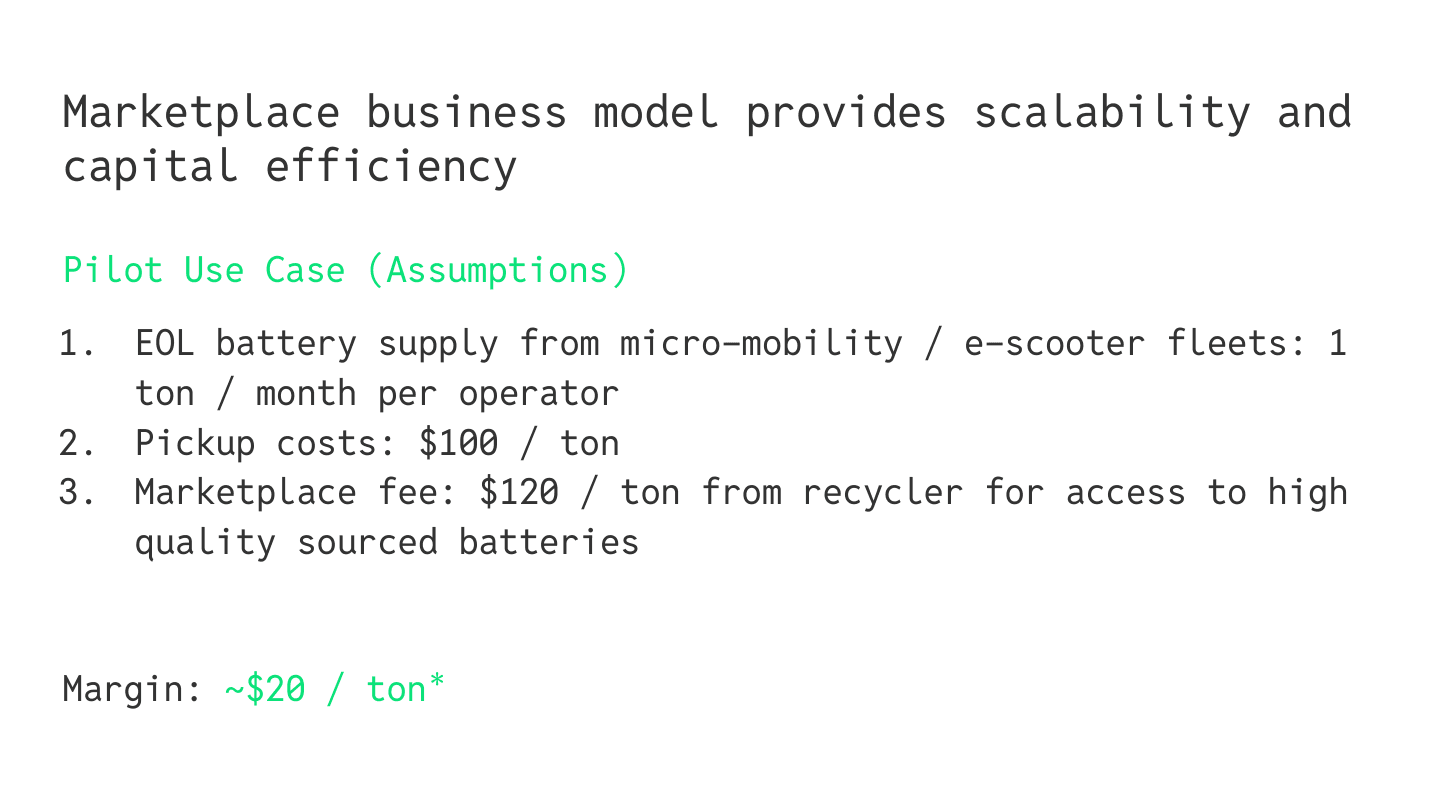
Marketplace model, charged to the recycler side. The pilot unit economics:
- EOL battery supply from micro-mobility/e-scooter fleets: 1 ton/month per operator
- Pickup cost: $100/ton
- Marketplace fee charged to recycler: $120/ton
- Margin: ~$20/ton
Thin margin per ton, but that's the entry point. The real play is scale — route density compresses logistics cost, and more recyclers on the platform improves pricing for suppliers, which attracts more supply.
growth and network effects
The model compounds in both directions:
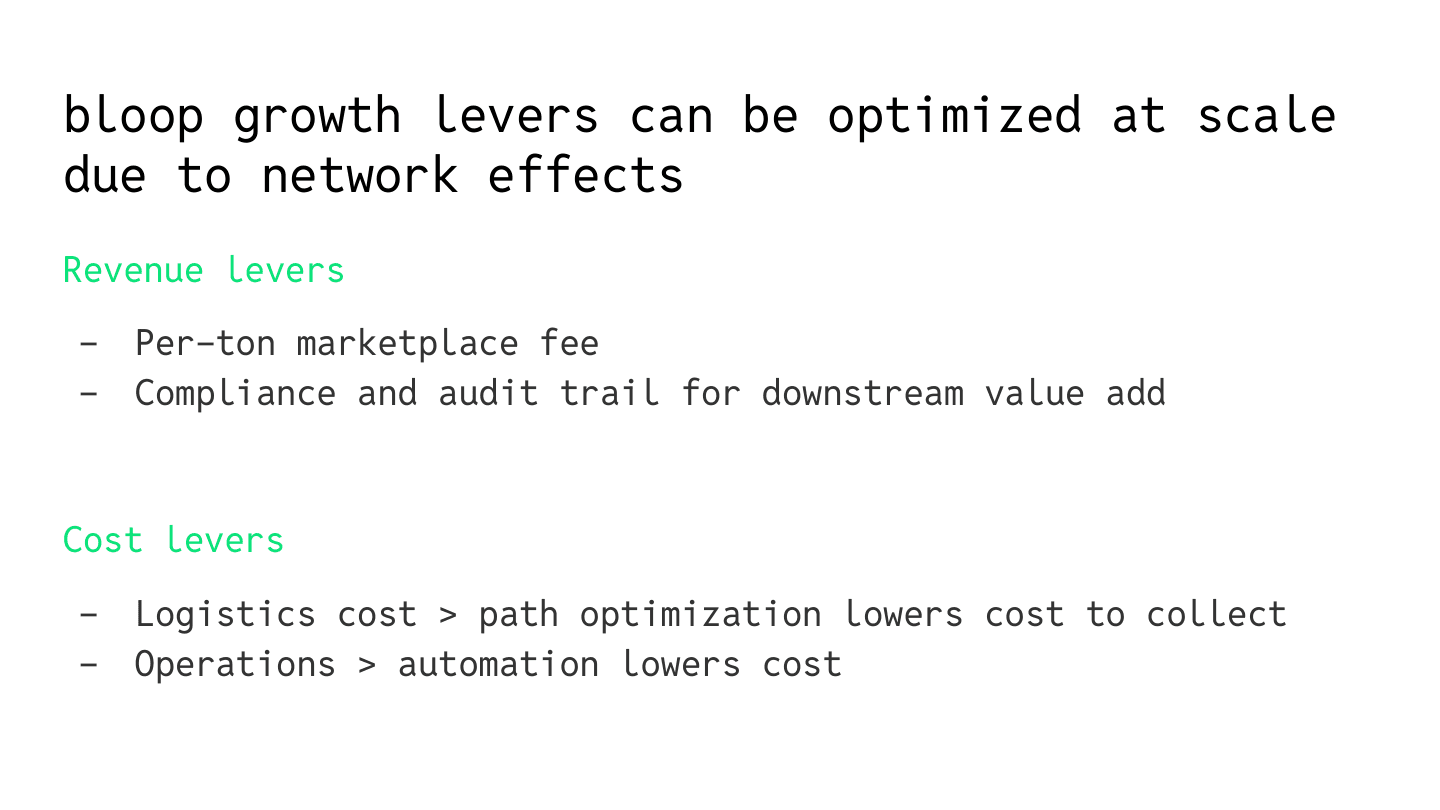
Revenue levers — per-ton marketplace fee as baseline; compliance and audit trail documentation as a value-add layer for downstream processors.
Cost levers — logistics is the biggest cost. Path optimisation at volume lowers cost per pickup. Operational automation reduces overhead as transaction count scales.
More recyclers → better pricing for suppliers → more supply enters the network → route density increases → lower cost per pickup → margins improve. Standard marketplace flywheel, applied to industrial waste.
expansion
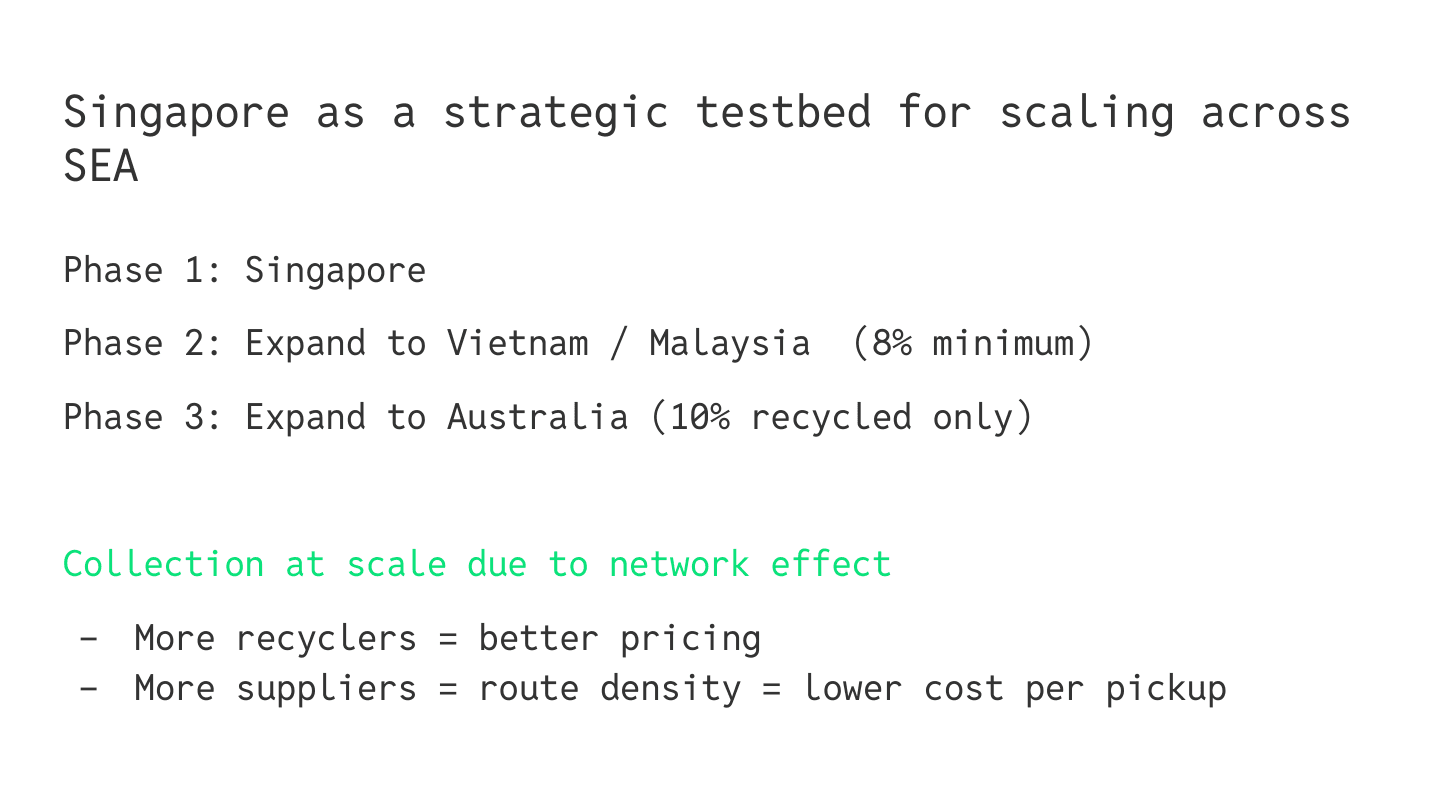
Singapore first — tight geography, strong regulatory environment, and a measurable baseline (6% recycling rate) to improve against.
Phase 2: Vietnam and Malaysia, where battery recycling rates are even lower (8% minimum) and e-mobility adoption is growing fast. Phase 3: Australia, where only 10% of batteries are recycled despite regulatory pressure to do better.
use of funds
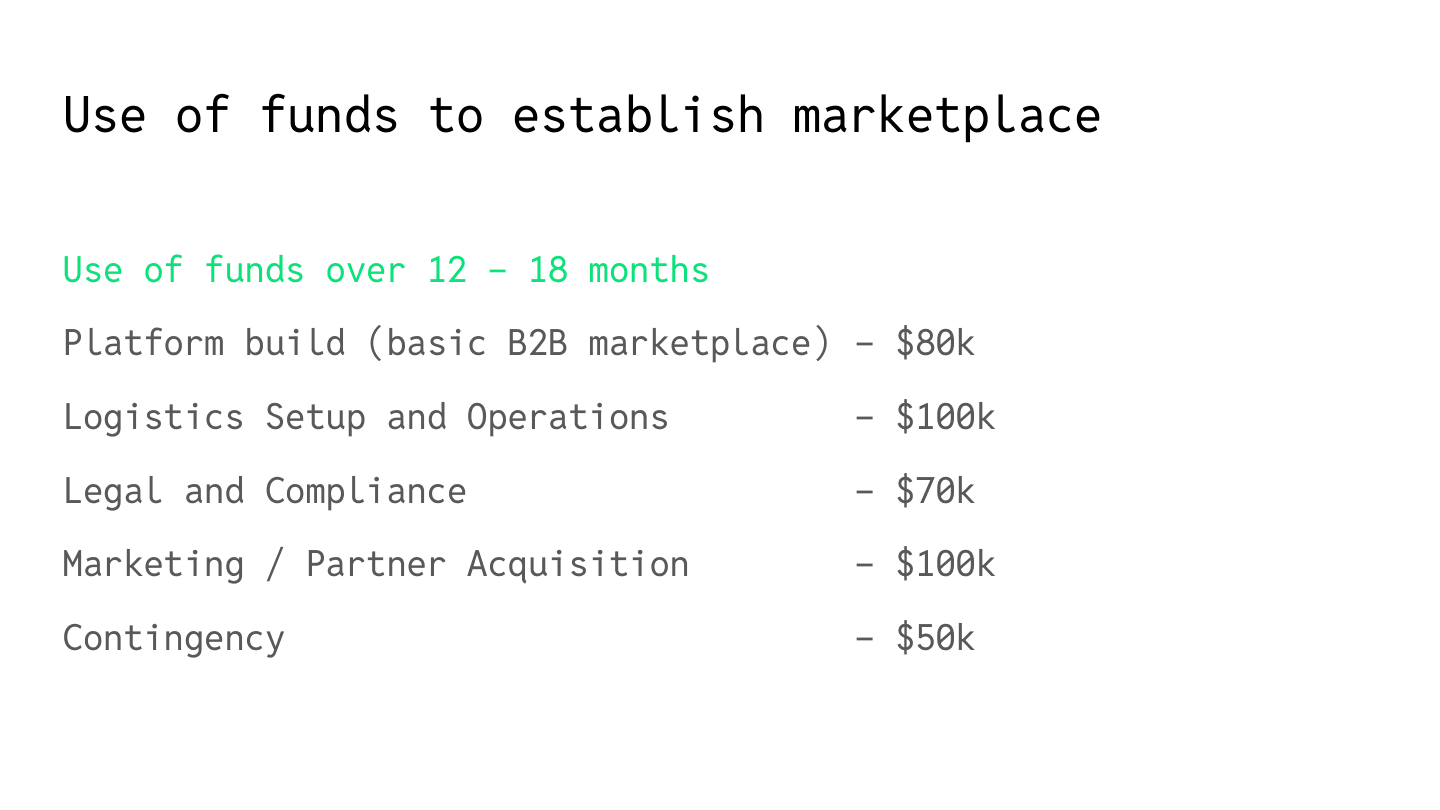
$400k over 12–18 months to establish the marketplace:
- Platform build (basic B2B marketplace): $80k
- Logistics setup and operations: $100k
- Legal and compliance: $70k
- Marketing / partner acquisition: $100k
- Contingency: $50k
Lean. Most of the budget goes to logistics operations and partner acquisition — the hard parts that can't be automated away at the start.
the downstream play
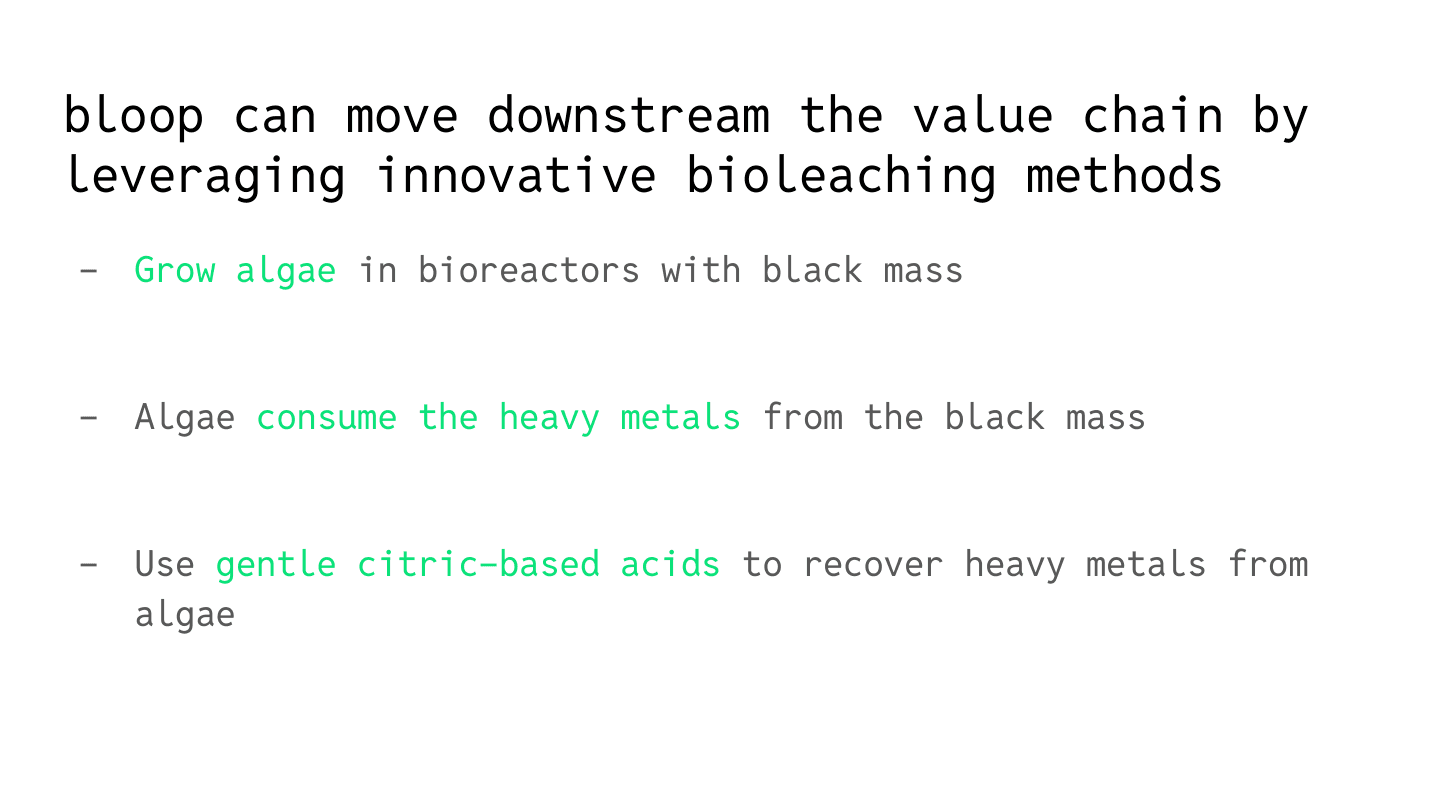
The longer-term vision was moving downstream into actual material recovery. The interesting angle here was bioleaching — an emerging approach where:
- Algae are grown in bioreactors with black mass (the processed output of shredded batteries)
- The algae consume heavy metals from the black mass
- Citric-based acids are then used to recover the heavy metals from the algae
Gentler than conventional hydrometallurgical processing, potentially cheaper at scale. The marketplace becomes the feedstock network for a proprietary recovery operation.
why ENGIE Factory
ENGIE is an energy infrastructure company. Their portfolio touches power grids, EV charging, and industrial energy systems — all of which have battery waste exposure. An EIR building bloop inside ENGIE Factory would have had immediate access to supply-side relationships, regulatory credibility, and a ready-made customer base for the compliance layer.
The fit was real. They wanted it. The timing just didn't line up.
what happened
Passed the EIR selection. Turned down the offer. Joined Circles as Product Lead in June 2025.
bloop was the right idea for the context — a cleantech marketplace with a defensible logistics moat, a clear expansion path, and a strategic partner who could open the supply side overnight. The decision to go to Circles was about where I wanted to build product and what kind of operator I wanted to become at that moment. Not a rejection of the idea.